


LEMY
The Virgin, Klimt (1913)
The Virgin, Klimt (1913)

Couldn't load pickup availability
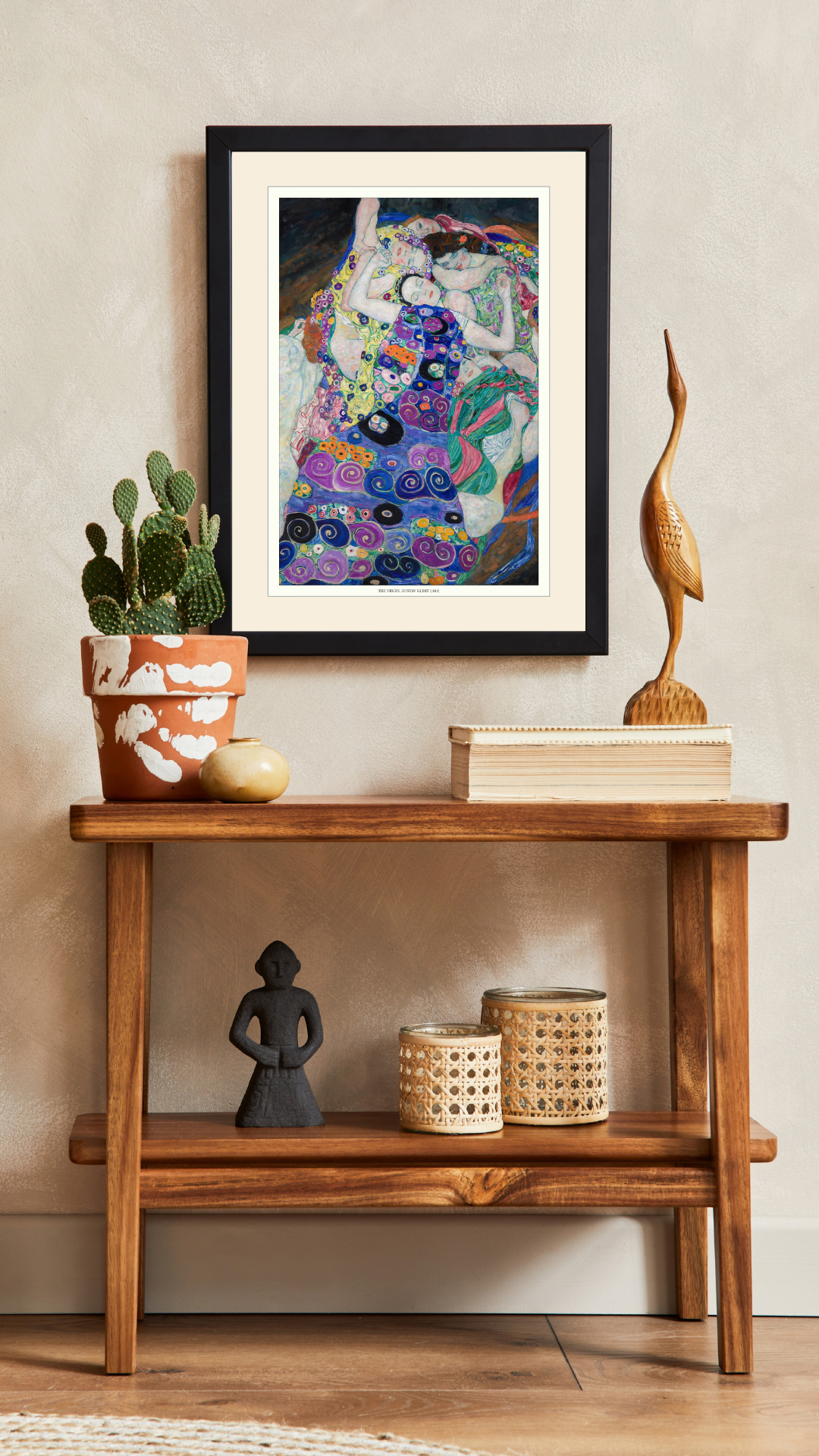
In The Virgin, Gustav Klimt abandons the burnished gold surfaces that defined his earlier work and enters a radiant, color-saturated world of pattern, sensuality, and transformation. A cluster of intertwined young women floats within a kaleidoscope of purples, blues, yellows, and floral forms, their bodies woven into an ornamental cosmos that feels both dreamlike and intensely alive. The composition forms a pyramidal swirl of intertwined figures, their pale skin tinged with cool blues and soft pinks, echoing the expressive corporeality seen in the work of Klimt’s Viennese contemporary Egon Schiele.
At the center, a serene, mask-like face with closed eyes emerges from a wave of violet fabric. This is the titular virgin, suspended between innocence and awakening. Her expression holds calm anticipation rather than seduction; she dreams rather than desires. Around her, blossoms erupt and patterns pulse with life, suggesting emotions and sensual awareness beginning to stir beneath the surface. Klimt shifts attention away from the individual body toward rhythm, color, and decorative pattern, allowing sensation and transformation to take visual form.
The painting reflects Klimt’s late stylistic evolution, in which influences from Fauvist color, Japanese textiles, and Byzantine mosaics converge into a vivid ornamental language. The flat, patterned space dissolves depth while intensifying movement, pushing representation toward abstraction without abandoning the human figure. Here, sensuality is not the dangerous allure of the femme fatale found in Klimt’s earlier works, but a dreamlike state of becoming, a threshold between girlhood and adult desire.
Painted five years before his death, The Virgin belongs to Klimt’s final creative period, when his art embraced color, pattern, and psychological nuance with renewed freedom. A related meditation on transition appears in his unfinished work The Bride (1917–18), where the theme of feminine transformation continues into a new phase of life.
Bring The Virgin into your home and it introduces a world of luminous color and quiet emotional depth. Its swirling forms and dreamlike calm evoke anticipation, transformation, and the tender threshold between innocence and awakening.
LEMY BUYER PROTECTION
If your art arrives damaged, we offer a full refund or replacement - just contact us on WhatsApp within 48 hours.
View full details




MUSEUM GRADE

FREE DELIVERY

4,000+
